

Aritmética
| Aritmética | |||||||||||
|---|---|---|---|---|---|---|---|---|---|---|---|
| |||||||||||
| |||||||||||
| |||||||||||
| Wikidata G:Commons C:Commons | |||||||||||
A aritmética[1] (do grego αριθμός = número) é unha das máis antigas ramas elementais das matemáticas que trata de operacións numéricas como a suma, a resta, a multiplicación e a división. Nun sentido máis amplo, tamén inclúe a potenciación, a extracción de raíces e a obtención de logaritmos.
Comunmente enténdese por aritmética a parte da álxebra elemental ensinada na escola primaria que estuda os números e as operacións básicas que con eles se fan. Os matemáticos tamén falan dunha aritmética superior coa que designan á teoría de números.
Os sistemas aritméticos poden clasificarse segundo o tipo de números cos que operan. A aritmética dos números enteiros refírese aos cálculos con números enteiros positivos e negativos. A aritmética dos números racionais implica operacións con fraccións de números enteiros. A aritmética dos números reais refírese aos cálculos con números reais, que inclúen tanto os números racionais como os números irracionais.
Outra distinción baséase no sistema numérico empregado para realizar cálculos. A aritmética decimal é a máis común. Utiliza os díxitos básicos do 0 ao 9 e as súas combinacións para expresar números. A aritmética binaria, pola contra, é a que utilizan a maioría dos ordenadores e representa os números como combinacións dos díxitos básicos 0 e 1. A aritmética informática ocúpase das particularidades da implementación da aritmética binaria nos ordenadores. Algúns sistemas aritméticos operan con obxectos matemáticos distintos dos números, como a aritmética de intervalos e a aritmética de matrices.
As operacións aritméticas constitúen a base de moitas ramas das matemáticas, como a álxebra, o cálculo e a estatística. Desempeñan un papel similar nas ciencias, como a física e a economía. A aritmética está presente en moitos aspectos da vida cotiá, por exemplo, para calcular o cambio ao facer a compra ou para xestionar as finanzas persoais. É unha das primeiras formas de educación matemática coas que se atopan os estudantes. Os seus fundamentos cognitivos e conceptuais son obxecto de estudo por parte da psicoloxía e a filosofía.
Antigamente a aritmética cinguíase ao estudo das propiedades dos números naturais, dos números enteiros, e dos números racionais (en forma de fraccións), así como das propiedades das operacións entre estes números. As operacións aritméticas tradicionais son a adición, a subtracción, a multiplicación e a división.
Máis tarde esta disciplina medrou, incluíndo o estudo doutros números coma os reais (considerados como expresións numéricas cun número ilimitado de cifras decimais), e de operacións máis complexas derivadas das operacións aritméticas básicas coma as raíces cadradas, as potencias, a exponenciación e os logaritmos.
A práctica da aritmética remóntase polo menos a miles e posiblemente a decenas de miles de anos. Civilizacións antigas como os antigos exipcios e os sumerios inventaron sistemas numéricos para resolver problemas aritméticos prácticos ao redor do ano 3000 a. C. A partir dos séculos VII e VI a. C., os antigos gregos iniciaron un estudo máis abstracto dos números e introduciron o método das demostracións matemáticas rigorosas. Os antigos indios desenvolveron o concepto do cero e o sistema decimal, que os matemáticos árabes perfeccionaron aínda máis e difundiron ao mundo occidental durante a Idade Media. As primeiras calculadoras mecánicas inventáronse no século XVII. Os séculos XVIII e XIX foron testemuñas do desenvolvemento da teoría de números moderna e da formulación dos fundamentos axiomáticos da aritmética. No século XX, a aparición das calculadoras e os ordenadores revolucionou a precisión e a velocidade coa que se podían realizar os cálculos aritméticos.
Definición, etimoloxía e campos relacionados
[editar | editar a fonte]O termo «aritmética» ten a súa orixe no termo latino «arithmetica», que á súa vez deriva das palabras do grego antigo «ἀριθμός» («arithmos»), que significa "número" , e «ἀριθμητική τέχνη» («arithmetike tekhne»), que significa "a arte de contar".[2]
Existen discrepancias sobre a súa definición exacta. Segundo unha interpretación restritiva, a aritmética ocúpase unicamente dos números naturais.[3] Con todo, a opinión máis estendida é que o seu ámbito de aplicación inclúa operacións con números enteiros, racionais, reais e, en ocasións, tamén complexos.[4] Algunhas definicións limitan a aritmética ao ámbito dos cálculos numéricos.[5] Se se entende nun sentido máis amplo, tamén inclúe o estudo de como se desenvolveu o concepto de números, a análise das propiedades e as relacións entre os números, e o exame da estrutura axiomática das operacións aritméticas.[6]
A aritmética está estreitamente relacionada coa teoría de números e algúns autores utilizan ambos os termos como sinónimos.[7] Con todo, nun sentido máis específico, a teoría de números limítase ao estudo dos números enteiros e céntrase nas súas propiedades e relacións, como a divisibilidade, a factorización e a primalidade.[8] Tradicionalmente, coñécese como aritmética superior.[9]
Números
[editar | editar a fonte]Os números son obxectos matemáticos que se utilizan para contar cantidades e medir magnitudes. Son elementos fundamentais da aritmética, xa que todas as operacións aritméticas realízanse con números. Existen diferentes tipos de números e diferentes sistemas numéricos para representalos.[10]
Tipos
[editar | editar a fonte]
Os principais tipos de números que se utilizan en aritmética son os números naturais, os enteiros, os racionais e os reais.[11] Os números naturais son números enteiros que van desde o 1 até o infinito. Non inclúen o 0 nin os números negativos. Tamén se coñecen como números de contar e pódense expresar como . O símbolo dos números naturais é .[a] Os números enteiros son idénticos aos números naturais, coa única diferenza de que inclúen o 0. Pódense representar como e teñen o símbolo .[13][b] Algúns matemáticos non establecen a distinción entre os números naturais e os números enteiros, xa que inclúen o 0 no conxunto dos números naturais.[15] O conxunto dos números enteiros inclúe tanto os números enteiros positivos como os negativos. Denótase co símbolo e pode expresarse como .[16]
Segundo o uso que se faga dos números naturais e enteiros, pódense distinguir en cardinais e ordinais. Os números cardinais, como un, dous e tres, son números que expresan a cantidade de obxectos. Responden á pregunta "cantos?". Os números ordinais, como primeiro, segundo e terceiro, indican a orde ou a posición nunha serie. Responden á pregunta "en que posición?".[17]
Un número é racional se pode representarse como a razón entre dous números enteiros. Por exemplo, o número racional obtense dividindo o número enteiro 1, chamado numerador, polo número enteiro 2, chamado denominador. Outros exemplos son e . O conxunto dos números racionais inclúe todos os números enteiros, que son fraccións cun denominador igual a 1. O símbolo dos números racionais é .[18] As fraccións decimais como 0,3 e 25,12 son un tipo especial de números racionais, xa que o seu denominador é unha potencia de 10. Por exemplo, 0,3 é igual a , e 25,12 é igual a .[19] Cada número racional corresponde a un número finito ou a un decimal periódico.[20][c]

Os números irracionais son números que non poden expresarse como a relación entre dous números enteiros. A miúdo son necesarios para describir magnitudes xeométricas. Por exemplo, se un triángulo rectángulo ten os catetos de lonxitude 1, entón a lonxitude da súa hipotenusa vén dada polo número irracional . π é outro número irracional e describe a relación entre a circunferencia dun círculo e o seu diámetro.[21] A representación decimal dun número irracional é unha sucesión infinita de decimais que non se repiten.[22] O conxunto dos números racionais, xunto co conxunto dos números irracionais, forma o conxunto dos números reais. O símbolo dos números reais é .[23] Entre as clases de números aínda máis amplas inclúense os números complexos e os cuaternións.[24]
Sistema de numeración
[editar | editar a fonte]- Artigo principal: Sistema de numeración.
Un díxito é un símbolo que representa un número, e os sistemas numéricos son marcos de representación.[25] Polo xeral, contan cun número limitado de números básicos, que se refiren directamente a determinados números. O sistema establece como se poden combinar estes números básicos para expresar calquera número.[26] Os sistemas numéricos poden ser posicionais ou non posicionais. Todos os primeiros sistemas numéricos eran non posicionais.[27] Nos sistemas numéricos non posicionais, o valor dun díxito non depende da súa posición no número.[28]
O sistema non posicional máis sinxelo é o sistema de numeración unario. Baséase nun só símbolo para o número 1. Todos os números maiores escríbense repetindo este símbolo. Por exemplo, o número 7 pode representarse repetindo sete veces o símbolo do 1. Este sistema fai que resulte engorroso escribir números grandes, polo que moitos sistemas non posicionales inclúen símbolos adicionais para representar directamente os números máis grandes.[29] As variantes dos sistemas numéricos unarios utilízanse nos paus de cálculo, mediante muescas, e nas marcas de cálculo.[30]
Historia
[editar | editar a fonte]


Os máis famosos restos de operacións aritméticas realizados na prehistoria atópanse no chamado óso de Ishango datado ao redor do 20.000 a.C. Pénsase que este óso marcouse co fin de servir como axuda para operar con números.[31]
Semella claro que ao redor do -1850 os Babilonios xa tiñan un coñecemento sólido de boa parte da aritmética elemental, se nos baseamos no achado de táboas de arxila coma a Plimpton 322, que contén unha lista de números escritos en formato sexaxesimal correspondentes a sinxelas ternas pitagóricas. Tamén os exipcios tiñan extensos coñecementos aritméticos, así coma de xeometría, como amosa o papiro matemático Rhind escrito ao redor do -1650. No tocante ós contidos aritméticos cabe resaltar que neste papiro se pode xa atopar un algoritmo de multiplicación, así coma o emprego de fraccións da unidade.
Na segunda metade do século VI a.C., na escola pitagórica considerábase á aritmética coma unha das catro ciencias matemáticas (Mathemata). Na idade media a aritmética formaba parte do Quadrivium (aritmética, xeometría, música e astronomía) ensinado por Alcuíno na Academia Palatina, que xunto co Trivium (gramática, retórica e dialéctica) constitúen as sete artes liberais ensinadas nas universidades medievais.
Os algoritmos aritméticos modernos son posibles grazas á introdución do sistema de numeración hindú-arábigo e a notación decimal posicional dos números. A aritmética baseada neste sistema de numeración desenvolveuse ao longo de varios séculos coa contribución dos grandes matemáticos hindús Aryabhata, Brahmagupta e Bhaskara I. Aryabhata probou diferentes formas de notación posicional; Brahmagupta desenvolveu as modernas suma, resta, multiplicación e división baseadas na numeración hindú; e Bhaskara I semella ser o primeiro en empregar unha notación puramente decimal, introducindo un símbolo para o cero. A aritmética de hoxe en día descende dos métodos orixinarios da India, que xunto co sistema numérico hindú asimiláronse polos árabes e foron transmitidos por estes na Idade Media aos europeos. Con anterioridade ao uso destes métodos, a realización de operacións aritméticas básicas era unha tarefa complicada. No ano 662, algunhas pasaxes escritas polo bispo nestoriano persa Severus Sebokht, amosan que daquela a ciencia e o sistema de numeración hindú eran xa coñecidos e apreciados por persoas do oriente medio.[32]

A aritmética hindú era máis sinxela que a grega xa que o sistema numérico hindú era posicional e tiña número cero. Os árabes asimilaron as técnicas da ciencia hindú, que logo transmitiron a través dos seus escritos aos europeos. A obra máis antiga que chegou a nós explicando o sistema de numeración decimal e a súa aritmética, é un dos manuscritos do matemático persa do século IX Al-Khwarizmi do cal desgraciadamente só se conservan algunhas versións latinas pouco fieis ao orixinal.
A primeira aparición en Europa dos números hindús foi no Codex Vigilanus copiado por un monxe rioxano no ano 976, aínda que pasarían varios séculos antes de seren aceptados. Na súa difusión xogou un papel importante o "Liber Abaci" do matemático italiano Fibonacci, publicado en Pisa no ano 1202.
Operacións aritméticas
[editar | editar a fonte]
As operacións aritméticas básicas son a adición ou suma, a subtracción ou resta, a multiplicación e a división, aínda que en ocasións se inclúen operacións máis avanzadas, como os cálculos de porcentaxes, as raíces cadradas, a potenciación, a exponenciación e os logaritmos. A aritmética realízase seguindo unha orde de operacións. Calquera conxunto de obxectos no que se poidan realizar as catro operacións básicas (agás a división entre 0) ten a estrutura de corpo.[33]
Instrumentos de cálculo
[editar | editar a fonte]Os utensilios para facilitar as contas numéricas foron empregados a través de miles de anos. Por exemplo contar cos dedos, establecendo unha correspondencia cos dedos da man. O primeiro obxecto para contar probablemente fose un «pau de contar». Registros posteriores no Crecente Fértil inclúen cálculos (esferas de barro, conos etc.) que representan contas de obxectos, posiblemente grans.[34] Outro exemplo é a numeración con varas.
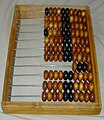
O ábaco foi empregado dende tempos moi antigos para tarefas aritméticas. Usábase en Babilonia no 2400 a.C. e dende entón aparecereon diferentes táboas. Antes da Idade Media construíronse varias computadoras analóxicas para facer cálculos astronómicos, como a máquina de Antikythera e o astrolabio na antiga Grecia (150-100 a.C.).[35] Herón de Alexandría (c. 10–70) construíu aparellos complexos, incluíndo autómatas e tarxetas programables.[36]
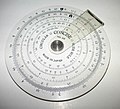
O matemático escocés John Napier decatouse que a multiplicación e a división dos números podía transformarse en sumas e restas empregando o logaritmo dos números. Mentres construía as súas táboas logarítmicas necesitou facer moitas multiplicacións, para o que deseñou os "ósos de Napier". As regras de cálculo foron usadas por xeracións de enxeñeiros antes da invención das calculadoras de peto.[37]
- Conta cos dedos
- Pau de contar
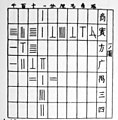
- Numeración chinesa con varas
- Táboa babilónica
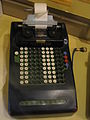
- Máquina de sumar
- Calculadora de peto
Alta aritmética
[editar | editar a fonte]- Artigo principal: Teoría dos números.
O termo aritmética tamén fai referencia á teoría dos números, que desenvolve e afonda nas propiedades dos números enteiros relacionadas coa súa primalidade, divisibilidade e as solucións enteiras das ecuacións. En particular, o teorema fundamental da aritmética e as funcións aritméticas desenvólvense dentro deste cadro e este é o uso que se reflicte en A Course in Arithmetic de Jean-Pierre Serre, ou o que dá Harold Davenport en frases como: "aritmética de primeira orde" ou "alta aritmética".
- A aritmética modular trata das congruencias de números enteiros; o seu estudo inscríbese na teoría dos números.
- A aritmética binaria e a álxebra de Boole, moi empregadas en informática, é o cálculo aritmético efecutado nun sistema de numeración binario e a álxebra resultante. Foi documentada por Leibniz, no século XVII, no seu artigo Explication de l'Arithmétique Binaire.
- A aritmética ordinal, en teoría de conxuntos, describe o cálculo aritmético coas operacións (suma, multiplicación e potenciación) aplicadas aos números ordinais.
- A aritmética de Peano é o conxunto de axiomas de construción dos números naturais.
- O teorema de incompletitude de Gödel, enunciado en 1930, demostra que ningunha teoría matemática formal capaz de describir os números naturais e a aritmética con suficiente expresividade é a vez consistente e completa.
Notas
[editar | editar a fonte]- Referencias
- ↑ Definicións no Dicionario da Real Academia Galega e no Portal das Palabras para aritmética.
- ↑ Peirce 2015, p. 109
Waite 2013, p. 42
Smith 1958, p. 7 - ↑ Oliver 2005, p. 58
Hofweber 2016, p. 153 - ↑ Romanowski 2008, pp. 302–303
HC staff 2022b
MW staff 2023 | Bukhshtab & Pechaev 2020 - ↑ Sophian 2017, p. 84
- ↑ Bukhshtab & Pechaev 2020
Stevenson & Waite 2011, p. 70
Romanowski 2008, pp. 303–304 - ↑ Lozano-Robledo 2019, p. xiii
Nagel & Newman 2008, p. 4 - ↑ Wilson 2020, pp. 1–2
Karatsuba 2020
Campbell 2012, p. 33
Robbins 2006, p. 1 }} - ↑ Duverney 2010, p. v
Robbins 2006, p. 1 - ↑ Romanowski 2008, pp. 302–304
Khattar 2010, pp. 1–2
Nakov & Kolev 2013, pp. 270–271 - ↑ Nagel 2002, pp. 180–181
Luderer, Nollau & Vetters 2013, p. 9
Khattar 2010, pp. 1–2 - ↑ Bukhshtab & Nechaev 2016
Zhang 2012, p. 130
Körner 2019, p. 109
International Organization for Standardization 2019, p. 4 - ↑ Romanowski 2008, p. 304
Nagel 2002, pp. 180–181
Hindry 2011, p. x | Bukhshtab & Nechaev 2016 - ↑ Swanson 2021, p. 107
Rossi 2011, p. 111 - ↑ Rajan 2022, p. 17
Hafstrom 2013, p. 6 - ↑ Romanowski 2008, p. 304
Nagel 2002, pp. 180–181
Hindry 2011, p. x
Hafstrom 2013, p. 95 - ↑ Orr 1995, p. 49
Nelson 2019, p. xxxi - ↑ Romanowski 2008, p. 304
Nagel 2002, pp. 180–181
Hindry 2011, p. x
Hafstrom 2013, p. 123 - ↑ Gellert et al. 2012, p. 33
- ↑ Musser, Peterson & Burger 2013, p. 358
- ↑ Romanowski 2008, p. 304
Nagel 2002, pp. 180–181
Hindry 2011, p. x - ↑ {Musser, Peterson & Burger 2013, pp. 358–359
Rooney 2021, p. 34 }} - ↑ Romanowski 2008, p. 304
Hindry 2011, p. x - ↑ Hindry 2011, p. x
Ward 2012, p. 55 - ↑ Ore 1948, pp. 1–2
HC staff 2022
HC staff 2022a - ↑ Ore 1948, pp. 8–10
Nakov & Kolev 2013, pp. 270–272 - ↑ Stakhov 2020, p. 73
Nakov & Kolev 2013, pp. 271–272
Jena 2021, pp. 17–18 - ↑ Nakov & Kolev 2013, pp. 271–272
Jena 2021, pp. 17–18 - ↑ Ore 1948, pp. 8–10
Mazumder & Ebong 2023, pp. 18–19
Moncayo 2018, p. 25 - ↑ Ore 1948, p. 8
Mazumder & Ebong 2023, p. 18 - ↑ Huylebrouck, Dirk (2019). "Africa and Mathematics". Mathematics, Culture, and the Arts. Missing Link. Cham: Springer International Publishing. pp. 153–166. ISBN 978-3-030-04036-9. doi:10.1007/978-3-030-04037-6_9. Consultado o 8 de abril do 2026.
- ↑ J.J. O'Connor e E.F. Robertson (traducido ao castelán por J. Armesto). The MacTutor History of Mathematics archive, University of St Andrews, Escocia, ed. "La numeración árabe". Arquivado dende o orixinal o 15 de xullo de 2007. Consultado o 12 de xullo de 2007.
- ↑ Tapson, Frank (1996). The Oxford Mathematics Study Dictionary. Oxford University Press. ISBN 0 19 914551 2.
- ↑ Robson, Eleanor (2008). Mathematics in Ancient Iraq. ISBN 978-0-691-09182-2..
- ↑ Lazos 1994
- ↑ Noel Sharkey (4 de xullo de 2007). "A programmable robot from 60 AD". New Scientist.
- ↑ Kells, Kern & Bland 1943, p. 82
Véxase tamén
[editar | editar a fonte]Bibliografía
[editar | editar a fonte]- Achatz, Thomas; Anderson, John G. (2005). Technical Shop Mathematics (en inglés). Industrial Press Inc. ISBN 978-0-8311-3086-2.
- Adamowicz, Zofia (1994). "The Power of Exponentiation in Arithmetic". En Joseph, Anthony; Mignot, Fulbert; Murat, François; Prum, Bernard; Rentschler, Rudolf. First European Congress of Mathematics: Paris, July 6-10, 1992 Volume I Invited Lectures (Part 1) (en inglés). Birkhäuser. pp. 299–320. ISBN 978-3-0348-9110-3. doi:10.1007/978-3-0348-9110-3_9.
- Adhami, Reza; Meenen, Peter M.; Meenen, Peter; Hite, Denis (2007). Fundamental Concepts in Electrical and Computer Engineering with Practical Design Problems (en inglés). Universal-Publishers. ISBN 978-1-58112-971-7.
- Ali Rahman, Ernna Sukinnah; Shahrill, Masitah; Abbas, Nor Arifahwati; Tan, Abby (2017). "Developing Students' Mathematical Skills Involving Order of Operations". International Journal of Research in Education and Science. p. 373. doi:10.21890/ijres.327896 (inactivo 11 de xullo de 2025).
- Ang, Tian Se; Lam, Lay Yong (2004). Fleeting Footsteps: Tracing The Conception Of Arithmetic And Algebra In Ancient China (en inglés) (Revised ed.). World Scientific. ISBN 978-981-4483-60-5.
- Asano, Akihito (2013). An Introduction to Mathematics for Economics. Cambridge University Press. ISBN 978-1-107-00760-4.
- Askew, Mike (2010). "It Ain't (Just) What You Do: Effective Teachers of Numeracy". En Ian, Thompson. Issues In Teaching Numeracy In Primary Schools (en inglés). McGraw-Hill Education (UK). ISBN 978-0-335-24153-8.
- Aubrey, Carol (1999). A Developmental Approach to Early Numeracy: Helping to Raise Children's Achievements and Deal with Difficulties in Learning (en inglés). A&C Black. ISBN 978-1-4411-9164-9.
- Bagaria, Joan (2023). "Set Theory". The Stanford Encyclopedia of Philosophy. Metaphysics Research Lab, Stanford University. Consultado o 19 November 2023.
- Barnes, Andrew J.; Rice, Thomase; Hanoch, Yaniv (2017). "Using Behavioral Economics to Improve People's Decisions About Purchasing Health Insurance". En Hanoch, Yaniv; Barnes, Andrew; Rice, Thomas. Behavioral Economics and Healthy Behaviors: Key Concepts and Current Research (en inglés). Taylor & Francis. ISBN 978-1-317-26952-6.
- Berch, Daniel B.; Geary, David C.; Koepke, Kathleen Mann (2015). Development of Mathematical Cognition: Neural Substrates and Genetic Influences (en inglés). Academic Press. ISBN 978-0-12-801909-2.
- Bird, John (2021). Bird's Engineering Mathematics (en inglés). Taylor & Francis. ISBN 978-0-367-64378-2.
- Bloch, Ethan D. (2011). The Real Numbers and Real Analysis (en inglés). Springer Science & Business Media. ISBN 978-0-387-72177-4.
- Bohacek, Peter (2009). "Introduction to Measurement". Teaching Quantitative Skills in the Geosciences. Carleton College Science Education Resource Center; American Association of Physics Teachers. Consultado o 2024-03-06.
- Booker, George; Bond, Denise; Sparrow, Len; Swan, Paul (2015). Teaching Primary Mathematics (en inglés). Pearson Higher Education AU. ISBN 978-1-4860-0488-1.
- Bradley, Michael J. (2006). The Birth of Mathematics: Ancient Times To 1300 (en inglés). Infobase Publishing. ISBN 978-0-7910-9723-6.
- Brent, Richard P.; Zimmermann, Paul (2010). Modern Computer Arithmetic (en inglés). Cambridge University Press. ISBN 978-1-139-49228-7.
- Bronshtein, I. N.; Semendyayev, K. A.; Musiol, Gerhard; Mühlig, Heiner (2015). Handbook of Mathematics (en inglés). Springer. ISBN 978-3-662-46221-8.
- Brown, David (2010). "The Measurement of Time and Distance in the Heavens Above Mesopotamia, with Brief Reference Made to Other Ancient Astral Science". En Morley, Iain; Renfrew, Colin. The Archaeology of Measurement: Comprehending Heaven, Earth and Time in Ancient Societies (en inglés). Cambridge University Press. ISBN 978-0-521-11990-0.
- Bruderer, Herbert (2021). Milestones in Analog and Digital Computing (en inglés). Springer Nature. ISBN 978-3-030-40974-6.
- Budd, Christopher J.; Sangwin, Christopher (2001). Mathematics Galore!: Masterclasses, Workshops and Team Projects in Mathematics and Its Applications (en inglés). OUP Oxford. ISBN 978-0-19-850770-3.
- Bukhshtab, A. A.; Nechaev, V. I. (2014). "Elementary Number Theory". Encyclopedia of Mathematics. Springer. Consultado o 23 October 2023.
- Bukhshtab, A. A.; Nechaev, V. I. (2016). "Natural Number". Encyclopedia of Mathematics. Springer. Consultado o 23 October 2023.
- Bukhshtab, A. A.; Pechaev, V. I. (2020). "Arithmetic". Encyclopedia of Mathematics. Springer. Arquivado dende o orixinal o 04 de outubro de 2009. Consultado o 23 October 2023.
- Burgin, Mark (2022). Trilogy Of Numbers And Arithmetic - Book 1: History Of Numbers And Arithmetic: An Information Perspective (en inglés). World Scientific. ISBN 978-981-12-3685-3.
- Cafaro, Massimo; Epicoco, Italo; Pulimeno, Marco (2018). "Techniques for Designing Bioinformatics Algorithms". Encyclopedia of Bioinformatics and Computational Biology: ABC of Bioinformatics (en inglés). Elsevier. ISBN 978-0-12-811432-2.
- Cai, Tianxin (2023). A Brief History of Mathematics: A Promenade Through the Civilizations of Our World (en inglés). Springer Nature. ISBN 978-3-031-26841-0.
- Campbell, Stephen R. (2012). "Understanding Elementary Number Theory in Relation to Arithmetic and Algebra". En Zazkis, Rina; Campbell, Stephen R. Number Theory in Mathematics Education: Perspectives and Prospects (en inglés). Routledge. ISBN 978-1-136-50143-2.
- Campbell-Kelly, Martin; Croarken, Mary; Flood, Raymond; Robson, Eleanor (2007). The History of Mathematical Tables: From Sumer to Spreadsheets (en inglés). OUP. ISBN 978-0-19-850841-0.
- Caprio, Michele; Aveni, Andrea; Mukherjee, Sayan (2022). "Concerning Three Classes of Non-Diophantine Arithmetics". Involve: A Journal of Mathematics 15 (5). pp. 763–774. arXiv:2102.04197. doi:10.2140/involve.2022.15.763.
- Carraher, David W.; Schliemann, Analucia D. (2015). "Powerful Ideas in Elementary School Mathematics". En English, Lyn D.; Kirshner, David. Handbook of International Research in Mathematics Education (en inglés). Routledge. ISBN 978-1-134-62664-9.
- Cavanagh, Joseph (2017). "6. Fixed-Point Multiplication". Computer Arithmetic and Verilog HDL Fundamentals (en inglés). CRC Press. ISBN 978-1-351-83411-7.
- Chakraverty, Snehashish; Rout, Saudamini (2022). Affine Arithmetic Based Solution of Uncertain Static and Dynamic Problems (en inglés). Springer Nature. ISBN 978-3-031-02424-5.
- Chemla, Karine; Keller, Agathe; Proust, Christine (2023). Cultures of Computation and Quantification in the Ancient World: Numbers, Measurements, and Operations in Documents from Mesopotamia, China and South Asia (en inglés). Springer Nature. ISBN 978-3-030-98361-1.
- Cignoni, Gioanni A.; Cossu, Giovanni A. (2016). "The Global Virtual Museum of Information Science & Technology, a Project Idea". En Tatnall, Arthur; Leslie, Christopher. International Communities of Invention and Innovation: IFIP WG 9.7 International Conference on the History of Computing, HC 2016, Brooklyn, NY, USA, May 25-29, 2016, Revised Selected Papers (en inglés). Springer. ISBN 978-3-319-49463-0.
- Cohen, Joel S. (2003). Computer Algebra and Symbolic Computation: Mathematical Methods (en inglés). CRC Press. ISBN 978-1-4398-6370-1.
- Colyvan, Mark (2023). "Indispensability Arguments in the Philosophy of Mathematics". The Stanford Encyclopedia of Philosophy. Metaphysics Research Lab, Stanford University. Consultado o 20 March 2024.
- Confrey, Jere (1994). "Splitting, Similarity, and Rate of Change: A New Approach to Multiplication and Exponential Functions". En Harel, Guershon; Confrey, Jere. The Development of Multiplicative Reasoning in the Learning of Mathematics (en inglés). State University of New York Press. ISBN 978-1-4384-0580-3.
- Conradie, Willem; Goranko, Valentin (2015). Logic and Discrete Mathematics: A Concise Introduction (en inglés). John Wiley & Sons. ISBN 978-1-118-76109-0.
- Cryer, C. W. (2014). A Math Primer for Engineers (en inglés). IOS Press. ISBN 978-1-61499-299-8.
- Cunningham, Daniel W. (2016). Set Theory: A First Course (en inglés). Cambridge University Press. ISBN 978-1-316-68204-3.
- Curley, Robert (2011). Computing: From the Abacus to the iPad (en inglés). Britannica Educational Publishing. ISBN 978-1-61530-707-4.
- Cuyt, Annie A. M.; Petersen, Vigdis; Verdonk, Brigitte; Waadeland, Haakon; Jones, William B. (2008). Handbook of Continued Fractions for Special Functions (en inglés). Springer Science & Business Media. ISBN 978-1-4020-6949-9.
- Davis, Andrew; Goulding, Maria; Suggate, Jennifer (2017). Mathematical Knowledge for Primary Teachers (en inglés). Taylor & Francis. ISBN 978-1-317-21901-9.
- De Cruz, Helen; Neth, Hansjörg; Schlimm, Dirk (2010). "The Cognitive Basis of Arithmetic". En Löwe, Benedikt; Müller, Thomas. PhiMSAMP: Philosophy of Mathematics : Sociological Aspsects and Mathematical Practice (en inglés). College Publications. ISBN 978-1-904987-95-6.
- Dowker, Ann (2019). Individual Differences in Arithmetic: Implications for Psychology, Neuroscience and Education (en inglés). Routledge. ISBN 978-1-317-62743-2.
- Dreeben-Irimia, Olga (2010). Patient Education in Rehabilitation (en inglés). Jones & Bartlett Publishers. ISBN 978-1-4496-1775-2.
- Drosg, Manfred (2007). Dealing with Uncertainties. Springer. ISBN 978-3-540-29606-5.
- Duffy, Daniel J. (2018). Financial Instrument Pricing Using C++ (en inglés). John Wiley & Sons. ISBN 978-1-119-17048-8.
- Duverney, Daniel (2010). Number Theory: An Elementary Introduction Through Diophantine Problems (en inglés). World Scientific. ISBN 978-981-4307-46-8.
- Ebby, Caroline B.; Hulbert, Elizabeth T.; Broadhead, Rachel M. (2020). A Focus on Addition and Subtraction: Bringing Mathematics Education Research to the Classroom (en inglés). Routledge. ISBN 978-1-000-22087-2.
- Emerson, Jane; Babtie, Patricia (2014). The Dyscalculia Solution: Teaching Number Sense (en inglés). Bloomsbury Publishing. ISBN 978-1-4729-2099-7.
- Eriksson, Kenneth; Estep, Donald; Johnson, Claes (2013). Applied Mathematics: Body and Soul: Volume 2: Integrals and Geometry in IRn (en inglés). Springer Science & Business Media. ISBN 978-3-662-05798-8.
- Farmer, William M. (2023). Simple Type Theory: A Practical Logic for Expressing and Reasoning About Mathematical Ideas (en inglés). Springer Nature. ISBN 978-3-031-21112-6.
- Ferreiros, Jose (2013). Labyrinth of Thought: A History of Set Theory and Its Role in Modern Mathematics (en inglés). Birkhäuser. ISBN 978-3-0348-5049-0.
- Gallistel, C. R.; Gelman, R. (2005). "Mathematical Cognition". En Holyoak, K. J.; Morrison, R. G. The Cambridge Handbook of Thinking and Reasoning. Cambridge University Press. ISBN 978-0-521-53101-6.
- Geary, David C. (2006). "Development of Mathematical Understanding". En Damon, William; Lerner, Richard M.; Kuhn, Deanna; Siegler, Robert S. Handbook of Child Psychology, Cognition, Perception, and Language (en inglés). John Wiley & Sons. ISBN 978-0-470-05054-5.
- Gellert, W.; Hellwich, M.; Kästner, H.; Küstner, H. (2012). The VNR Concise Encyclopedia of Mathematics (en inglés). Springer Science & Business Media. ISBN 978-94-011-6982-0.
- Gerardi, Kristopher; Goette, Lorenz; Meier, Stephan (2013). "Numerical Ability Predicts Mortgage Default". Proceedings of the National Academy of Sciences 110 (28). pp. 11267–11271. Bibcode:2013PNAS..11011267G. PMC 3710828. PMID 23798401. doi:10.1073/pnas.1220568110.
- Goodstein, R. L. (2014). Fundamental Concepts of Mathematics (en inglés). Elsevier. ISBN 978-1-4831-5405-3.
- Grice, Matt; Kemp, Simon; Morton, Nicola J.; Grace, Randolph C. (2023). "The Psychological Scaffolding of Arithmetic". Psychological Review 131 (2). pp. 494–522. PMID 37358523. doi:10.1037/rev0000431.
- Grigorieva, Ellina (2018). Methods of Solving Number Theory Problems (en inglés). Birkhäuser. ISBN 978-3-319-90915-8.
- Griffin, Carroll W. (1935). "Significant Figures". National Mathematics Magazine 10 (1). pp. 20–24. JSTOR 3028249. doi:10.2307/3028249.
- Gupta, Rajesh Kumar (2019). Numerical Methods: Fundamentals and Applications (en inglés). Cambridge University Press. ISBN 978-1-108-68660-0.
- Hafstrom, John Edward (2013). Basic Concepts in Modern Mathematics (en inglés). Courier Corporation. ISBN 978-0-486-31627-7.
- Hamilton, Norman T.; Landin, Joseph (2018). Set Theory: The Structure of Arithmetic (en inglés). Courier Dover Publications. ISBN 978-0-486-83047-6.
- Hart, Roger (2011). The Chinese Roots of Linear Algebra (en inglés). JHU Press. ISBN 978-0-8018-9958-4.
- Haylock, Derek; Cockburn, Anne D. (2008). Understanding Mathematics for Young Children: A Guide for Foundation Stage and Lower Primary Teachers (en inglés). SAGE. ISBN 978-1-4462-0497-9.
- HC staff (2022). "Numeral". American Heritage Dictionary. HarperCollins. Consultado o 11 November 2023.
- HC staff (2022a). "Number System". American Heritage Dictionary. HarperCollins. Consultado o 11 November 2023.
- HC staff (2022b). "Arithmetic". American Heritage Dictionary. HarperCollins. Consultado o 19 October 2023.
- Higham, Nicholas (2002). Accuracy and Stability of Numerical Algorithms (PDF) (2nd ed.). SIAM. ISBN 978-0-89871-521-7. doi:10.1137/1.9780898718027.
- Hindry, Marc (2011). Arithmetics. Universitext. Springer. ISBN 978-1-4471-2130-5. doi:10.1007/978-1-4471-2131-2.
- Hodgkin, Luke (2013). A History of Mathematics: From Mesopotamia to Modernity (en inglés). OUP Oxford. ISBN 978-0-19-166436-6.
- Hoffman, Joe D.; Frankel, Steven (2018). Numerical Methods for Engineers and Scientists (en inglés). CRC Press. ISBN 978-1-4822-7060-0.
- Hofweber, Thomas (2016). "The Philosophy of Arithmetic". Ontology and the Ambitions of Metaphysics (en inglés). Oxford University Press. ISBN 978-0-19-876983-5.
- Horsten, Leon (2023). "Philosophy of Mathematics". The Stanford Encyclopedia of Philosophy. Metaphysics Research Lab, Stanford University. Consultado o 22 November 2023.
- Hua, Jueming; Feng, Lisheng (2020). Thirty Great Inventions of China: From Millet Agriculture to Artemisinin (en inglés). Springer Nature. ISBN 978-981-15-6525-0.
- Husserl, Edmund; Willard, Dallas (2012). "Translator's Introduction". Philosophy of Arithmetic: Psychological and Logical Investigations with Supplementary Texts from 1887–1901 (en inglés). Springer Science & Business Media. ISBN 978-94-010-0060-4.
- Igarashi, Yoshihide; Altman, Tom; Funada, Mariko; Kamiyama, Barbara (2014). Computing: A Historical and Technical Perspective (en inglés). CRC Press. ISBN 978-1-4822-2741-3.
- International Organization for Standardization (2019). ISO 80000-2: 2019 Quantities and units Part 2: Mathematics (PDF). International Organization for Standardization.
- ITL Education Solutions Limited (2011). Introduction to Computer Science (en inglés). Pearson Education India. ISBN 978-81-317-6030-7.
- Jackson, Janna M. (2008). "Reading/Writing Connection". En Flippo, Rona F. Handbook of College Reading and Study Strategy Research (en inglés). Routledge. ISBN 978-1-135-70373-8.
- Jena, Sisir Kumar (2021). C Programming: Learn to Code (en inglés). CRC Press. ISBN 978-1-000-46056-8.
- Kaiser, Sarah C.; Granade, Christopher (2021). Learn Quantum Computing with Python and Q#: A Hands-on Approach (en inglés). Simon and Schuster. ISBN 978-1-61729-613-0.
- Karatsuba, A. A. (2014). "Analytic Number Theory". Encyclopedia of Mathematics. Springer. Arquivado dende o orixinal o 04 de outubro de 2023. Consultado o 23 October 2023.
- Karatsuba, A. A. (2020). "Number Theory". Encyclopedia of Mathematics. Springer. Arquivado dende o orixinal o 30 de outubro de 2023. Consultado o 23 October 2023.
- Kay, Anthony (2021). Number Systems: A Path into Rigorous Mathematics (en inglés). CRC Press. ISBN 978-0-429-60776-9.
- Khan, Khalid; Graham, Tony Lee (2018). Engineering Mathematics with Applications to Fire Engineering (en inglés). CRC Press. ISBN 978-1-351-59761-6.
- Khattar, Dinesh (2010). The Pearson Guide To Objective Arithmetic For Competitive Examinations, 3/E (en inglés). Pearson Education India. ISBN 978-81-317-2673-0.
- Khoury, Joseph; Lamothe, Gilles (2016). Mathematics That Power Our World, The: How Is It Made? (en inglés). World Scientific. ISBN 978-981-4730-86-0.
- Klaf, A. Albert (2011). Trigonometry Refresher (en inglés). Courier Corporation. ISBN 978-0-486-15104-5.
- Klein, Elise; Moeller, Korbinian; Dressel, Katharina; Domahs, Frank; Wood, Guilherme; Willmes, Klaus; Nuerk, Hans-Christoph (2010). "To Carry or Not to Carry — Is This the Question? Disentangling the Carry Effect in Multi-digit Addition". Acta Psychologica 135 (1). pp. 67–76. PMID 20580340. doi:10.1016/j.actpsy.2010.06.002.
- Klein, Andreas (2013). Stream Ciphers (en inglés). Springer Science & Business Media. ISBN 978-1-4471-5079-4.
- Klein, Jacob (2013a). Greek Mathematical Thought and the Origin of Algebra (en inglés). Courier Corporation. ISBN 978-0-486-31981-0.
- Kleiner, Israel (2012). Excursions in the History of Mathematics (en inglés). Springer Science & Business Media. ISBN 978-0-8176-8268-2.
- Klose, Orval M. (2014). The Number Systems and Operations of Arithmetic: An Explanation of the Fundamental Principles of Mathematics Which Underlie the Understanding and Use of Arithmetic, Designed for In-Service Training of Elementary School Teachers Candidates Service Training of Elementary School Teacher Candidates (en inglés). Elsevier. ISBN 978-1-4831-3709-4.
- Knobloch, Eberhard; Komatsu, Hikosaburo; Liu, Dun (2013). Seki, Founder of Modern Mathematics in Japan: A Commemoration on His Tercentenary (en inglés). Springer Science & Business Media. ISBN 978-4-431-54273-5.
- Koepf, Wolfram (2021). Computer Algebra: An Algorithm-Oriented Introduction (en inglés). Springer Nature. ISBN 978-3-030-78017-3.
- Koetsier, Teun (2018). The Ascent of GIM, the Global Intelligent Machine: A History of Production and Information Machines (en inglés). Springer. ISBN 978-3-319-96547-5.
- Koren, Israel (2018). Computer Arithmetic Algorithms (en inglés). CRC Press. ISBN 978-1-4398-6371-8.
- Körner, T. W. (2019). Where Do Numbers Come From? (en inglés). Cambridge University Press. ISBN 978-1-108-77594-6.
- Krenn, Stephan; Lorünser, Thomas (2023). An Introduction to Secret Sharing: A Systematic Overview and Guide for Protocol Selection (en inglés). Springer Nature. ISBN 978-3-031-28161-7.
- Kubilyus, I. P. (2018). "Number Theory, Probabilistic Methods in". Encyclopedia of Mathematics. Springer. Consultado o 23 October 2023.
- Kudryavtsev, L. D. (2020). "Real Number". Encyclopedia of Mathematics. Springer. Consultado o 23 October 2023.
- Kupferman, Raz (2015). Elementary School Mathematics For Parents And Teachers - Volume 1 (en inglés). World Scientific Publishing Company. ISBN 978-981-4699-93-8.
- Křížek, Michal; Somer, Lawrence; Šolcová, Alena (2021). From Great Discoveries in Number Theory to Applications (en inglés). Springer Nature. ISBN 978-3-030-83899-7.
- Lang, Serge (2002). "Taylor’s Formula". Short Calculus: The Original Edition of "A First Course in Calculus". Undergraduate Texts in Mathematics (en inglés). Springer. pp. 195–210. ISBN 978-1-4613-0077-9. doi:10.1007/978-1-4613-0077-9_14.
- Lang, Philippa (2015). Science: Antiquity and its Legacy (en inglés). Bloomsbury Publishing. ISBN 978-0-85773-955-1.
- Lange, Kenneth (2010). Numerical Analysis for Statisticians (en inglés). Springer Science & Business Media. ISBN 978-1-4419-5944-7.
- Laski, Elida V.; Jor’dan, Jamilah R.; Daoust, Carolyn; Murray, Angela K. (2015). "What Makes Mathematics Manipulatives Effective? Lessons From Cognitive Science and Montessori Education". SAGE Open 5 (2). doi:10.1177/2158244015589588. hdl:1808/20642.
- Lerner, Brenda Wilmoth; Lerner, K. Lee, eds. (2008). "Modular Arithmetic". The Gale Encyclopedia of Science (4th ed.). Thompson Gale. ISBN 978-1-4144-2877-2.
- Li, Yeping; Schoenfeld, Alan H. (2019). "Problematizing Teaching and Learning Mathematics as 'Given' in STEM Education". International Journal of STEM Education 6 (1). doi:10.1186/s40594-019-0197-9.
- Liebler, Robert A. (2018). Basic Matrix Algebra with Algorithms and Applications (en inglés). CRC Press. ISBN 978-0-429-85287-9.
- Lockhart, Paul (2017). Arithmetic. The Belknap Press of Harvard University Press. ISBN 978-0-674-97223-0.
- Lozano-Robledo, Álvaro (2019). Number Theory and Geometry: An Introduction to Arithmetic Geometry (en inglés). American Mathematical Soc. ISBN 978-1-4704-5016-8.
- Luderer, Bernd; Nollau, Volker; Vetters, Klaus (2013). Mathematical Formulas for Economists (en inglés). Springer Science & Business Media. ISBN 978-3-662-12431-4.
- Lützen, Jesper (2023). A History of Mathematical Impossibility (en inglés). Oxford University Press. ISBN 978-0-19-286739-1.
- Lustick, David (1997). "The Numbers Game: Playing up the importance of significant figures and scientific notation". The Science Teacher 64 (5). pp. 16–18. JSTOR 24152064.
- Ma, Liping (2020). Knowing and Teaching Elementary Mathematics: Teachers' Understanding of Fundamental Mathematics in China and the United States (en inglés). Routledge. ISBN 978-1-000-02734-1.
- Madden, Daniel J.; Aubrey, Jason A. (2017). An Introduction to Proof Through Real Analysis (en inglés). John Wiley & Sons. ISBN 978-1-119-31472-1.
- Mahajan, Sanjoy (2010). Street-Fighting Mathematics: The Art of Educated Guessing and Opportunistic Problem Solving (en inglés). MIT Press. ISBN 978-0-262-26559-1.
- Marcus, Russell; McEvoy, Mark (2016). An Historical Introduction to the Philosophy of Mathematics: A Reader (en inglés). Bloomsbury Publishing. ISBN 978-1-4725-3291-6.
- Mazumder, Pinaki; Ebong, Idongesit E. (2023). Lectures on Digital Design Principles (en inglés). CRC Press. ISBN 978-1-000-92194-6.
- Mazzola, Guerino; Milmeister, Gérard; Weissmann, Jody (2004). Comprehensive Mathematics For Computer Scientists 1: Sets And Numbers, Graphs And Algebra, Logic And Machines, Linear Geometry (en inglés). Springer Science & Business Media. ISBN 978-3-540-20835-8.
- Meyer, Carl D. (2023). Matrix Analysis and Applied Linear Algebra: Second Edition (en inglés). SIAM. ISBN 978-1-61197-744-8.
- Monahan, John F. (2012). "2. Basic Computational Algorithms". En Gentle, James E.; Härdle, Wolfgang Karl; Mori, Yuichi. Handbook of Computational Statistics: Concepts and Methods (en inglés). Springer Science & Business Media. ISBN 978-3-642-21551-3.
- Moncayo, Raul (2018). Lalangue, Sinthome, Jouissance, and Nomination: A Reading Companion and Commentary on Lacan's Seminar XXIII on the Sinthome (en inglés). Routledge. ISBN 978-0-429-91554-3.
- Mooney, Claire; Briggs, Mary; Hansen, Alice; McCullouch, Judith; Fletcher, Mike (2014). Primary Mathematics: Teaching Theory and Practice (en inglés). Learning Matters. ISBN 978-1-4739-0707-2.
- Moore, Ramon E.; Kearfott, R. Baker; Cloud, Michael J. (2009). Introduction to Interval Analysis (en inglés). SIAM. ISBN 978-0-89871-669-6.
- Muller, Jean-Michel; Brisebarre, Nicolas; Dinechin, Florent de; Jeannerod, Claude-Pierre; Lefèvre, Vincent; Melquiond, Guillaume; Revol, Nathalie; Stehlé, Damien; Torres, Serge (2009). Handbook of Floating-Point Arithmetic (en inglés). Springer Science & Business Media. ISBN 978-0-8176-4705-6.
- Muller, Jean-Michel; Brunie, Nicolas; Dinechin, Florent de; Jeannerod, Claude-Pierre; Joldes, Mioara; Lefèvre, Vincent; Melquiond, Guillaume; Revol, Nathalie; Torres, Serge (2018). Handbook of Floating-Point Arithmetic (en inglés). Birkhäuser. ISBN 978-3-319-76526-6.
- Musser, Gary L.; Peterson, Blake E.; Burger, William F. (2013). Mathematics for Elementary Teachers: A Contemporary Approach (en inglés). John Wiley & Sons. ISBN 978-1-118-48700-6.
- MW staff (2023). "Definition of Arithmetic". www.merriam-webster.com (en inglés). Consultado o 19 October 2023.
- Nagel, Rob (2002). U-X-L Encyclopedia of Science (en inglés). U-X-L. ISBN 978-0-7876-5440-5.
- Nagel, Ernest; Newman, James Roy (2008). Godel's Proof (en inglés). NYU Press. ISBN 978-0-8147-5837-3.
- Nakov, Svetlin; Kolev, Veselin (2013). Fundamentals of Computer Programming with C#: The Bulgarian C# Book (en inglés). Faber Publishing. ISBN 978-954-400-773-7.
- NCTM Staff. "Number and Operations". www.nctm.org. National Council of Teachers of Mathematics. Consultado o 21 November 2023.
- Nelson, Gerald (2019). English: An Essential Grammar (en inglés). Routledge. ISBN 978-1-351-12273-3.
- Null, Linda; Lobur, Julia (2006). The Essentials of Computer Organization and Architecture (en inglés). Jones & Bartlett Learning. ISBN 978-0-7637-3769-6.
- Nurnberger-Haag, Julie (2017). "Borrow, Trade, Regroup, or Unpack? Revealing How Instructional Metaphors Portray Base-Ten Number". En Jao, Limin; Radakovic, Nenad. Transdisciplinarity in Mathematics Education: Blurring Disciplinary Boundaries (en inglés). Springer. ISBN 978-3-319-63624-5.
- O'Leary, Michael L. (2015). A First Course in Mathematical Logic and Set Theory (en inglés). John Wiley & Sons. ISBN 978-0-470-90588-3.
- O'Regan, Gerard (2012). A Brief History of Computing (en inglés). Springer Science & Business Media. ISBN 978-1-4471-2359-0.
- Oakes, Elizabeth (2020). Encyclopedia of World Scientists, Updated Edition (en inglés). Infobase Publishing. ISBN 978-1-4381-9545-2.
- Odom, Samuel L.; Barbarin, Oscar A.; Wasik, Barbara Hanna (2009). "Applying Lessons from Developmental Science to Early Education". En Barbarin, Oscar A.; Wasik, Barbara Hanna. Handbook of Child Development and Early Education: Research to Practice (en inglés). Guilford Press. ISBN 978-1-60623-302-3.
- Oliver, Alexander D. (2005). "Arithmetic, Foundations of". En Honderich, Ted. The Oxford Companion to Philosophy. Oxford University Press. ISBN 978-0-19-926479-7.
- Omondi, Amos R. (2020). Cryptography Arithmetic: Algorithms and Hardware Architectures (en inglés). Springer Nature. ISBN 978-3-030-34142-8.
- Ongley, John; Carey, Rosalind (2013). Russell: A Guide for the Perplexed (en inglés). Bloomsbury Publishing. ISBN 978-1-4411-9123-6.
- Ore, Øystein (1948). Number Theory and Its History. McGraw-Hill. Dover reprint, 1988, ISBN 978-0-486-65620-5.
- Orr, David B. (1995). Fundamentals of Applied Statistics and Surveys (en inglés). CRC Press. ISBN 978-0-412-98821-9.
- Otis, Jessica Marie (2024). By the Numbers: Numeracy, Religion, and the Quantitative Transformation of Early Modern England (en inglés). Oxford University Press. ISBN 978-0-19-760877-7.
- Paar, Christof; Pelzl, Jan (2009). Understanding Cryptography: A Textbook for Students and Practitioners (en inglés). Springer Science & Business Media. ISBN 978-3-642-04101-3.
- Page, Robert L. (2003). "Number Theory, Elementary". Encyclopedia of Physical Science and Technology (Third ed.). Academic Press. ISBN 978-0-12-227410-7.
- Payne, Andrew (2017). The Teleology of Action in Plato's Republic (en inglés). Oxford University Press. ISBN 978-0-19-879902-3.
- Peirce, Charles S. (2015). Arithmetic (en inglés). Walter de Gruyter GmbH & Co KG. ISBN 978-3-11-086970-5.
- Pharr, Matt; Jakob, Wenzel; Humphreys, Greg (2023). Physically Based Rendering: From Theory to Implementation (en inglés) (4 ed.). MIT Press. ISBN 978-0-262-37403-3.
- Pomerance, Carl (2010). "IV.3 Computational Number Theory" (PDF). En Gowers, Timothy; Barrow-Green, June; Leader, Imre. The Princeton Companion to Mathematics. Princeton University Press. pp. 348–362. ISBN 978-1-4008-3039-8.
- Pomerance, C.; Sárközy, A. (1995). "Combinatorial Number Theory". En Graham, R. L. Handbook of Combinatorics (en inglés). Elsevier. ISBN 978-0-08-093384-9.
- Ponticorvo, Michela; Schmbri, Massimiliano; Miglino, Orazio (2019). "How to Improve Spatial and Numerical Cognition with a Game-Based and Technology-Enhanced Learning Approach". En Vicente, José Manuel Ferrández; Álvarez-Sánchez, José Ramón; López, Félix de la Paz; Moreo, Javier Toledo; Adeli, Hojjat. Understanding the Brain Function and Emotions: 8th International Work-Conference on the Interplay Between Natural and Artificial Computation, IWINAC 2019, Almería, Spain, June 3–7, 2019, Proceedings, Part I (en inglés). Springer. ISBN 978-3-030-19591-5.
- Prata, Stephen (2002). C Primer Plus (en inglés). Sams Publishing. ISBN 978-0-672-32222-8.
- Quintero, Ana Helvia; Rosario, Hector (2016). Math Makes Sense!: A Constructivist Approach To The Teaching And Learning Of Mathematics (en inglés). World Scientific. ISBN 978-1-78326-866-5.
- Rajan, Hridesh (2022). An Experiential Introduction to Principles of Programming Languages (en inglés). MIT Press. ISBN 978-0-262-36243-6.
- Reilly, Norman R. (2009). Introduction to Applied Algebraic Systems (en inglés). Oxford University Press. ISBN 978-0-19-970992-2.
- Reitano, Robert R. (2010). Introduction to Quantitative Finance: A Math Tool Kit (en inglés). MIT Press. ISBN 978-0-262-01369-7.
- Resnick, L. B.; Ford, W. W. (2012). Psychology of Mathematics for Instruction (en inglés). Routledge. ISBN 978-1-136-55759-0.
- Reynolds, Barbara E. (2008). "Abacus". En Selin, Helaine. Encyclopaedia of the History of Science, Technology, and Medicine in Non-Western Cultures (en inglés). Springer Science & Business Media. ISBN 978-1-4020-4559-2.
- Riesel, Hans (2012). Prime Numbers and Computer Methods for Factorization (en inglés). Springer Science & Business Media. ISBN 978-1-4612-0251-6.
- Rising, Gerald R.; Matthews, James R.; Schoaff, Eileen; Matthew, Judith (2021). About Mathematics (en inglés). Linus Learning. ISBN 978-1-60797-892-3.
- Robbins, Neville (2006). Beginning Number Theory (en inglés). Jones & Bartlett Learning. ISBN 978-0-7637-3768-9.
- Rodda, Harvey J. E.; Little, Max A. (2015). Understanding Mathematical and Statistical Techniques in Hydrology: An Examples-based Approach (en inglés). John Wiley & Sons. ISBN 978-1-119-07659-9.
- Roe, John; deForest, Russ; Jamshidi, Sara (2018). Mathematics for Sustainability (en inglés). Springer. ISBN 978-3-319-76660-7.
- Romanowski, Perry (2008). "Arithmetic". En Lerner, Brenda Wilmoth; Lerner, K. Lee. The Gale Encyclopedia of Science (4th ed.). Thompson Gale. ISBN 978-1-4144-2877-2.
- Rooney, Anne (2021). Think Like a Mathematician (en inglés). The Rosen Publishing Group. ISBN 978-1-4994-7092-5.
- Rossi, Richard J. (2011). Theorems, Corollaries, Lemmas, and Methods of Proof (en inglés). John Wiley & Sons. ISBN 978-1-118-03057-8.
- Ruthven, Kenneth (2012). "12. Calculators in the Mathematics Curriculum: The Scope of Personal Computational Technology". En Bishop, Alan; Clements, M. A. (Ken); Keitel-Kreidt, Christine; Kilpatrick, Jeremy; Laborde, Colette. International Handbook of Mathematics Education (en inglés). Springer Science & Business Media. ISBN 978-94-009-1465-0.
- Sally, Judith D.; Sally (Jr.), Paul J. (2012). Integers, Fractions, and Arithmetic: A Guide for Teachers (en inglés). American Mathematical Soc. ISBN 978-0-8218-8798-1.
- Seaman, William; Rossler, Otto E.; Burgin, Mark (2023). Chaos, Information, And The Future Of Physics: The Seaman-rossler Dialogue With Information Perspectives By Burgin And Seaman (en inglés). World Scientific. ISBN 978-981-12-7138-0.
- Shiva, Sajjan G. (2018). Introduction to Logic Design (en inglés). CRC Press. ISBN 978-1-351-98983-1.
- Sierpinska, Anna; Lerman, Stephen (1996). "Epistemologies of Mathematics and of Mathematics Education". En Alan J. Bishop; Ken Clements; Christine Keitel; Jeremy Kilpatrick; Colette Laborde. International Handbook of Mathematics Education: Part 1. Kluwer International Handbooks of Education, vol. 4 (en inglés). Springer Netherlands. pp. 827–876. ISBN 978-94-009-1465-0. doi:10.1007/978-94-009-1465-0_23.
- Smith, David E. (1958). History of Mathematics (en inglés). Courier Corporation. ISBN 978-0-486-20430-7.
- Smyth, William (1864). Elementary Algebra: For Schools and Academies (en inglés). Bailey and Noyes. OCLC 3901163143.
- Sophian, Catherine (2017). The Origins of Mathematical Knowledge in Childhood (en inglés). Routledge. ISBN 978-1-351-54175-6.
- Sperling, Abraham; Stuart, Monroe (1981). Mathematics. Elsevier Science. ISBN 978-0-7506-0405-5.
- Stakhov, Alexey (2020). Mathematics Of Harmony As A New Interdisciplinary Direction And 'Golden' Paradigm Of Modern Science - Volume 2: Algorithmic Measurement Theory, Fibonacci And Golden Arithmetic's And Ternary Mirror-symmetrical Arithmetic (en inglés). World Scientific. ISBN 978-981-12-1348-9.
- Sternberg, Robert J.; Ben-Zeev, Talia (2012). The Nature of Mathematical Thinking (en inglés). Routledge. ISBN 978-1-136-48750-7.
- Stevenson, Angus; Waite, Maurice (2011). Concise Oxford English Dictionary: Luxury Edition (en inglés). OUP Oxford. ISBN 978-0-19-960111-0.
- Stewart, David E. (2022). Numerical Analysis: A Graduate Course (en inglés). Springer Nature. ISBN 978-3-031-08121-7.
- Strathern, Paul (2012). Turing And The Computer (en inglés). Random House. ISBN 978-1-4481-0656-1.
- Swanson, Irena (2021). Introduction To Analysis With Complex Numbers (en inglés). World Scientific. ISBN 978-981-12-2587-1.
- Swartzlander, Earl E. (2017). "High-Speed Computer Arithmetic". En Oklobdzija, Vojin G. Digital Design and Fabrication (en inglés). CRC Press. ISBN 978-0-8493-8604-6.
- Tarasov, Vasily (2008). Quantum Mechanics of Non-Hamiltonian and Dissipative Systems (en inglés). Elsevier. ISBN 978-0-08-055971-1.
- Taylor, Joseph L. (2012). Foundations of Analysis (en inglés). American Mathematical Soc. ISBN 978-0-8218-8984-8.
- Thiam, Thierno; Rochon, Gilbert (2019). Sustainability, Emerging Technologies, and Pan-Africanism (en inglés). Springer Nature. ISBN 978-3-030-22180-5.
- Tiles, Mary (2009). "A Kantian Perspective on the Philosophy of Mathematics". En Irvine, Andrew D. Philosophy of Mathematics (en inglés). Elsevier. ISBN 978-0-08-093058-9.
- Uspenskii, V. A.; Semenov, A. L. (2001). "Solvable and Unsolvable Algorithmic Problems". En Tabachnikov, Serge. Kvant Selecta: Combinatorics, I: Combinatorics, I (en inglés). American Mathematical Soc. ISBN 978-0-8218-2171-8.
- Vaccaro, Alfredo; Pepiciello, Antonio (2022). Affine Arithmetic-Based Methods for Uncertain Power System Analysis (en inglés). Elsevier. ISBN 978-0-323-90503-9.
- Verschaffel, Lieven; Torbeyns, Joke; De Smedt, Bert (2011). "Mental Arithmetic". En Seel, Norbert M. Encyclopedia of the Sciences of Learning (en inglés). Springer Science & Business Media. ISBN 978-1-4419-1427-9.
- Victoria Department of Education Staff (2023). "Numeracy for All Learners". www.education.vic.gov.au (en inglés). Consultado o 22 November 2023.
- Vinogradov, A. I. (2019). "Algebraic Number Theory". Encyclopedia of Mathematics. Springer. Arquivado dende o orixinal o 04 de novembro de 2023. Consultado o 23 October 2023.
- Vullo, Vincenzo (2020). Gears: Volume 3: A Concise History (en inglés). Springer Nature. ISBN 978-3-030-40164-1.
- Waite, Maurice (2013). Pocket Oxford English Dictionary (en inglés). OUP Oxford. ISBN 978-0-19-966615-7.
- Wallis, W. D. (2011). A Beginner's Guide to Discrete Mathematics (en inglés). Springer Science & Business Media. ISBN 978-0-8176-8286-6.
- Wallis, W. D. (2013). A Beginner's Guide to Discrete Mathematics (en inglés). Springer Science & Business Media. ISBN 978-1-4757-3826-1.
- Wang, Hao (1997). A Logical Journey: From Gödel to Philosophy (en inglés). MIT Press. ISBN 978-0-262-26125-8.
- Ward, J. P. (2012). Quaternions and Cayley Numbers: Algebra and Applications (en inglés). Springer Science & Business Media. ISBN 978-94-011-5768-1.
- Wedell, Moritz (2015). "Numbers". En Classen, Albrecht. Handbook of Medieval Culture. Volume 2 (en inglés). Walter de Gruyter GmbH & Co KG. ISBN 978-3-11-037763-7.
- Weil, André (2009). Number Theory: An Approach Through History From Hammurapi to Legendre (en inglés). Springer Science & Business Media. ISBN 978-0-8176-4571-7.
- Weir, Alan (2022). "Formalism in the Philosophy of Mathematics". The Stanford Encyclopedia of Philosophy. Metaphysics Research Lab, Stanford University. Consultado o 22 November 2023.
- Wheater, Carolyn (2015). Algebra I (en inglés). Dorling Kindersley Limited. ISBN 978-0-241-88779-0.
- Wilson, Robin (2020). Number Theory: A Very Short Introduction (en inglés). Oxford University Press. ISBN 978-0-19-879809-5.
- Wright, Robert J.; Ellemor-Collins, David; Tabor, Pamela D. (2011). Developing Number Knowledge: Assessment, Teaching and Intervention with 7-11 Year Olds (en inglés). SAGE. ISBN 978-1-4462-8927-3.
- Xu, Zhiwei; Zhang, Jialin (2022). Computational Thinking: A Perspective on Computer Science (en inglés). Springer Nature. ISBN 978-981-16-3848-0.
- Yadin, Aharon (2016). Computer Systems Architecture (en inglés). CRC Press. ISBN 978-1-315-35592-4.
- Yan, Song Y. (2002). Number Theory for Computing (en inglés). Springer Science & Business Media. ISBN 978-3-642-07710-4.
- Yan, Song Y. (2013a). Computational Number Theory and Modern Cryptography (en inglés). John Wiley & Sons. ISBN 978-1-118-18858-3.
- Young, Cynthia Y. (2010). Precalculus (en inglés). John Wiley & Sons. ISBN 978-0-471-75684-2.
- Young, Cynthia Y. (2021). Algebra and Trigonometry (en inglés). John Wiley & Sons. ISBN 978-1-119-77830-1.
- Zhang, G. (2012). Logic of Domains (en inglés). Springer Science & Business Media. ISBN 978-1-4612-0445-9.
Ligazóns externas
[editar | editar a fonte]| Wikimedia Commons ten máis contidos multimedia na categoría: Aritmética |
- Referencia global en History Index
- "Mathematics in various cultures". Consultado o 9 de abril do 2026.
- Nicomachus Introduction to Arithmetic, traducido o inglés por Martin Luther D'ooge.
- What is arithmetic?